Wendy Koch · 31 August 2026
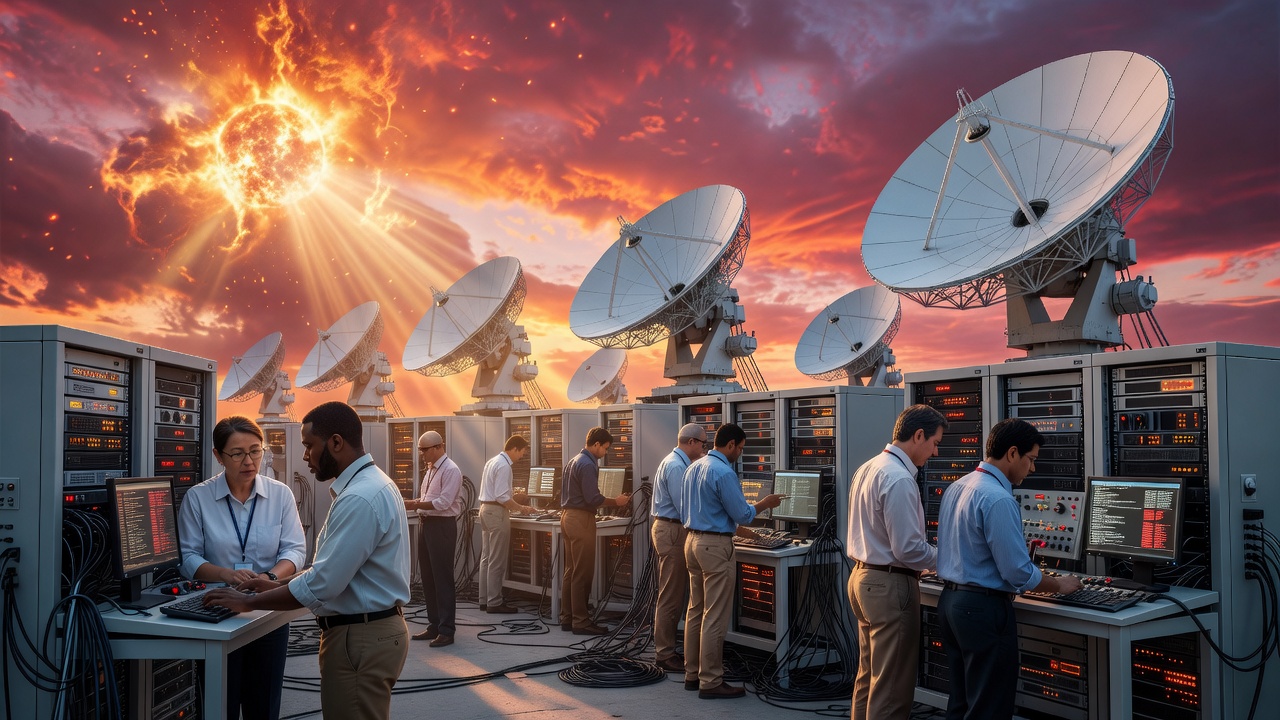
A powerful solar flare erupted from the sun's surface last week, sending waves of charged particles toward Earth and causing notable interference with satellite networks. Scientists monitoring solar activity at observatories worldwide noted the event's intensity, classifying it as an X-class flare, the strongest category. This phenomenon highlights the ongoing need for vigilance in space weather forecasting and the study of celestial bodies like the moon. Data collected indicates that such flares occur approximately every eleven years during the solar cycle peak.
Characteristics of the Recent Solar Event
The flare originated from active region 1234 on the sun, peaking at 14:32 UTC on October 15. Measurements from ground-based telescopes and space observatories indicated a significant release of energy, equivalent to billions of hydrogen bombs. Accompanying coronal mass ejections propelled plasma clouds into space at speeds exceeding 1,000 kilometers per second. These particles interacted with Earth's magnetosphere, leading to geomagnetic storms rated G3 on the NOAA scale. Observers of the moon also reported enhanced auroral activity visible at lower latitudes than usual, though the primary concern remained satellite functionality. Additional data from lunar observation stations confirmed increased radiation levels during the peak hours of the event.
Consequences for Global Satellite Infrastructure
Satellite operators reported temporary losses of signal and data transmission errors across multiple constellations, including those used for navigation and communications. The disruptions affected GPS accuracy in some regions, causing delays in aviation and maritime operations. Engineers implemented protective measures such as shutting down non-essential systems to prevent damage from induced currents. Recovery efforts took several hours, with full restoration achieved by the following day. Experts emphasize that while such events are infrequent, their potential to impact modern technology underscores the importance of robust monitoring programs focused on solar and lunar observations to predict future occurrences accurately. Continued research into these solar phenomena will help mitigate risks to orbital assets and ensure reliable service for users dependent on satellite technology. Future missions may incorporate advanced shielding to better withstand similar solar outbursts.